China Has a Chokehold on a Part Every Car Needs. This Nasdaq Company Is Racing to Break It. (Nasdaq: EMAT)
China’s dominance of rare earth magnets gives Beijing leverage over the global auto industry. With U.S. restrictions tightening, Evolution Metals (NASDAQ: EMAT) is scaling a non-China supply chain that could become increasingly critical to automakers and defense contractors.

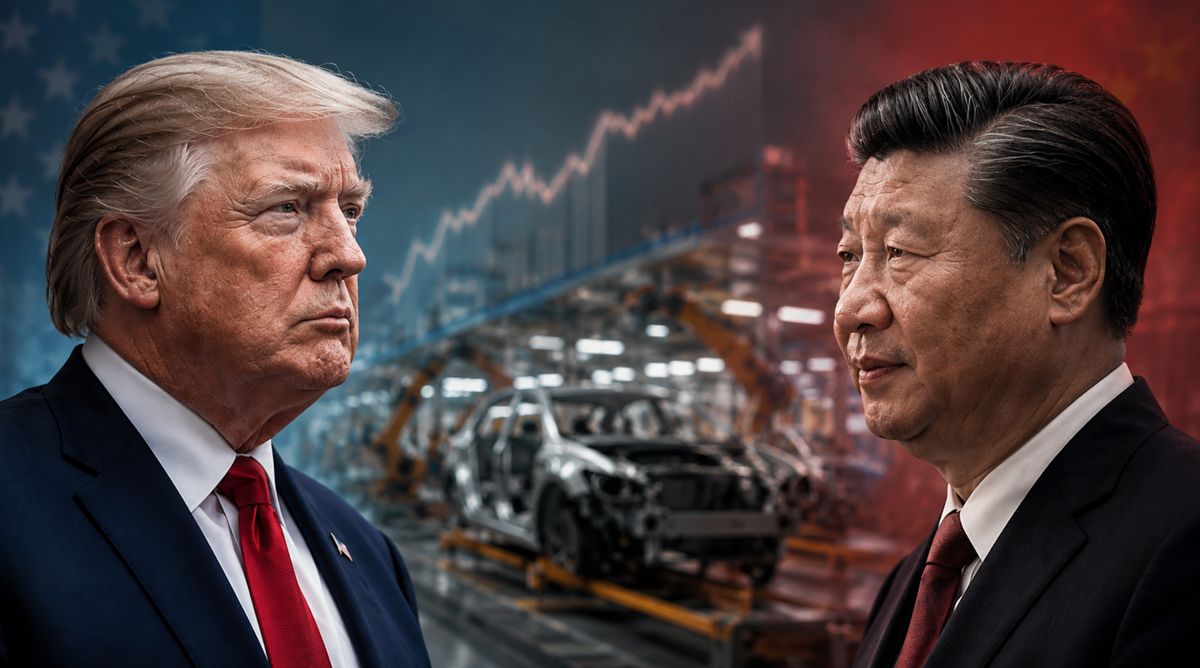
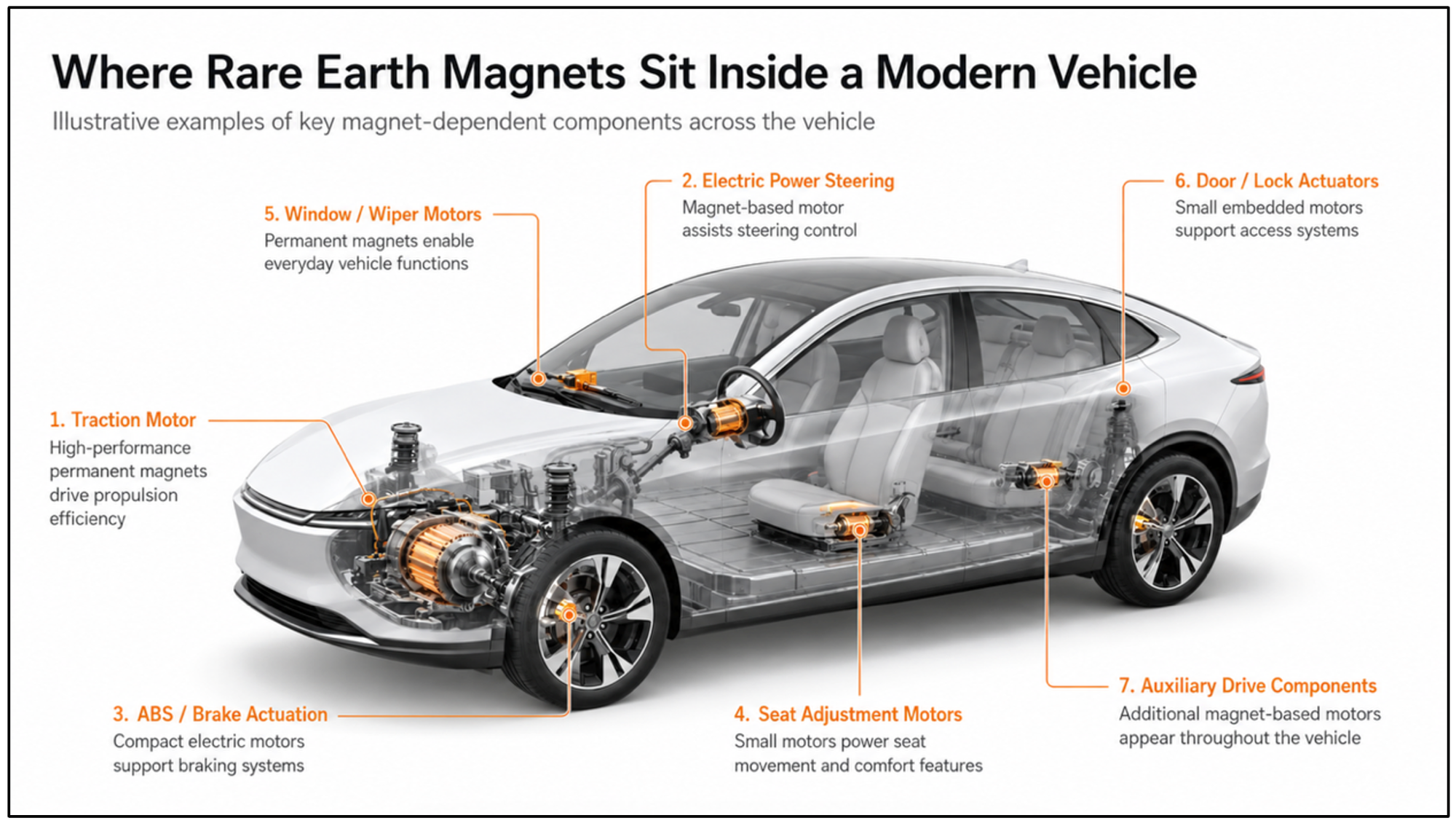
China could shut down auto manufacturing across the Western world without firing a single shot – just by stopping the shipment of magnets. Not the kind you stick on a fridge. Rare earth permanent magnets are found throughout modern vehicles - in the power steering, the anti-lock brakes, the seat motors, the windshield wipers, and dozens of other components. An electric vehicle adds 1 to 3 kilograms of magnet content for the traction motor alone. If these magnets disappear from the supply chain, the assembly line stops. For all vehicles - gas-powered, a hybrid battery, or a full EV drivetrain.
One company, Evolution Metals & Technologies Corp. (Nasdaq: EMAT), has built a non-China supply chain to address exactly this vulnerability, with more than 18 years of commercial-scale magnet production and a recently-announced order for 13 new production machines from ULVAC, a leading global manufacturer of magnet production equipment, that will significantly increase production capacity.
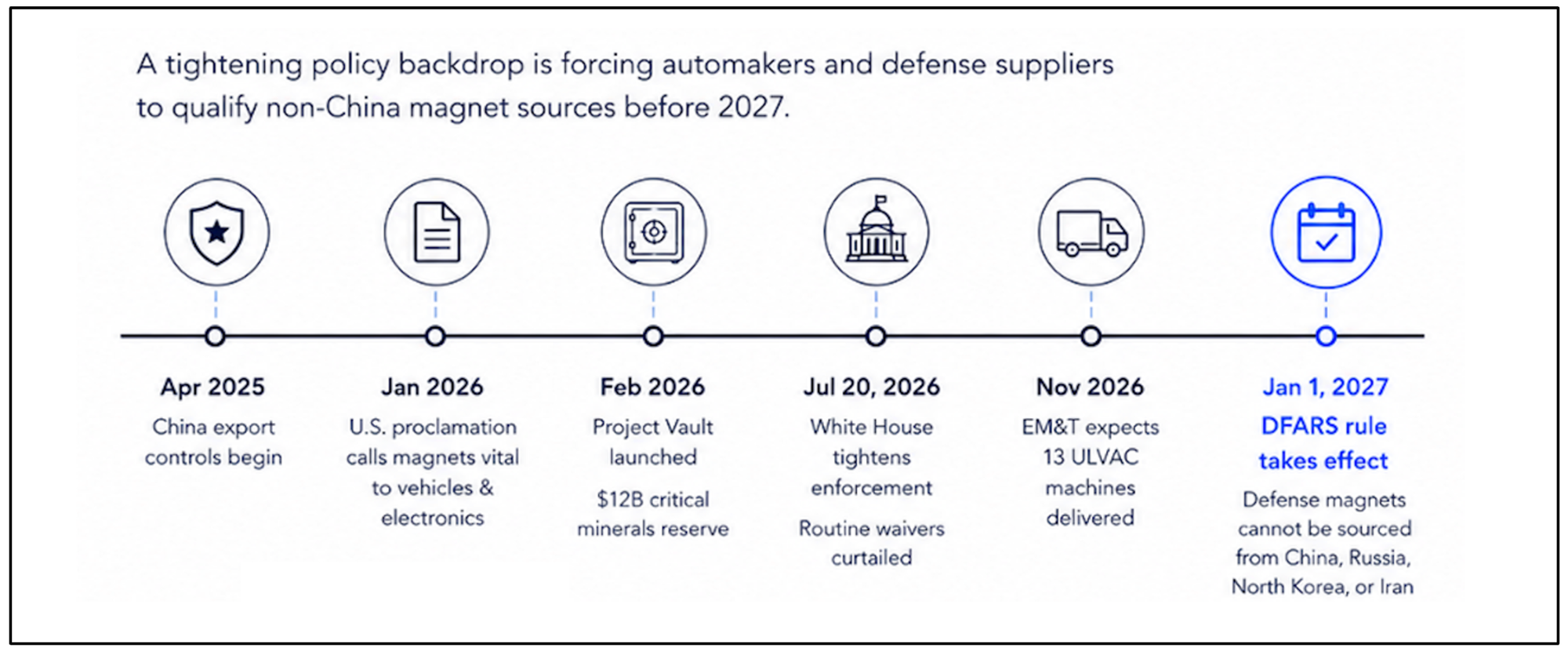
The chokehold is real. China produces roughly 90% of the world's rare earth permanent magnets and mines about 69% of the raw material that goes into them. When Beijing imposed export controls in April 2025, the impact hit fast: Ford halted Explorer production at its Chicago plant for a week because of a magnet shortage. Then, China announced a broader expansion of those controls in October 2025, though several of those additional measures were subsequently suspended through November 2026 as part of trade negotiations. Toyota CEO Koji Sato, speaking as chairman of the Japan Automobile Manufacturers Association in January 2026, listed securing stable procurement of critical resources as one of the industry's core strategic challenges.
Washington is responding, and the deadlines are real. The Pentagon has a procurement rule taking effect January 1, 2027 that will bar defense contractors from using rare earth magnets with materials sourced from China, Russia, North Korea, or Iran. On July 20, 2026, the White House issued an Executive Order tightening enforcement by ending routine waivers and requiring contractors to prove they are actively qualifying non-China sources. A January 2026 proclamation under the same trade-law authority used for steel and aluminum tariffs identified rare earth permanent magnets as "vital to nearly all electronics and vehicles." And the administration launched a $12 billion critical minerals reserve called Project Vault in February 2026. The message for companies supplying covered defense programs: find non-China magnet suppliers before January, or risk losing eligibility for defense work.
EM&T is positioned at the center of this convergence. The company operates what it believes is the only known commercial-scale, vertically integrated non-China rare earth magnet supply chain, from recycled electronics and high-grade concentrates through finished high-performance magnets. Its subsidiaries hold Tier-1 OEM quality certifications across six grades of sintered NdFeB magnets, including the heavy rare earth-containing compositions used in EV traction motors, defense systems, and robotics. The company has more than 18 years of commercial-scale magnet production serving global OEMs, a track record that, according to the company, distinguishes it from peers at the pilot or pre-commercial stage.
EM&T’s recent milestones tell the story. In May 2026, EM&T secured a convertible-debenture agreement providing for up to $100 million in potential funding, with an initial $20 million tranche closed and the remainder subject to future closings. The 13 ULVAC machines are scheduled for delivery in November 2026 and, once installed and commissioned, are expected to bring annual capacity to approximately 10,000 metric tons of rare earth magnets. And in July, the company took delivery of its first shipment of neodymium-praseodymium metal, the primary rare earth feedstock for high-performance magnets, sourced entirely outside China through SRE Vietnam. According to the company, that delivery represents an initial step toward establishing the traceable, non-China feedstock chain that defense compliance requires.
The bottom line is: rare earth magnets are not a niche EV component. They are the unseen, must-have infrastructure behind nearly every modern vehicle, and qualified non-China supply potentially sits behind every car that rolls off a Western assembly line. As EM&T CEO Frank Moon has framed it in a recent industry discussion: "EV competition erodes margins over time. Magnet shortages can shut down production in weeks." That asymmetry, and the policy urgency now reinforcing it, could draw increasing attention to the small number of companies working to close the gap.
Read this Next >> Ford's $30,000 Gamble: Why the Fathom EV Truck Is the Most Important Bet in Detroit
Recent News Highlights from Evolution Metals
Evolution Metals & Technologies Corp. Reports First Quarter 2026 Financial Results and Provides Corporate Update
Important Disclaimers and Disclosures: The author, Wall Street Wire, is a content and media technology platform that connects the market with under-the-radar companies. The platform operates a network of industry-focused media channels spanning finance, biopharma, cyber, AI, and additional sectors, delivering insights on both broader market developments and emerging or overlooked companies. Wall Street Wire is not a broker-dealer or investment adviser. References to market size estimates, valuations, price targets, or other third-party data are provided strictly for informational purposes. Wall Street Wire receives cash compensation from Evolution Metals and Technologies Corp (the "Issuer") for coverage and awareness services, which are provided on an ongoing subscription basis. The content above is a form of paid advertising and promotion and is for informational purposes only and does not constitute financial or investment advice. This article may contain forward-looking statements about the Issuer's products, plans, or prospects that are subject to risks and uncertainties; actual results may differ materially, and readers should review the Issuer's public filings on SEC EDGAR (sec.gov/edgar) for full risk factors. Market size figures, research estimates, or other third-party data referenced in this article are quoted from publicly available sources believed to be reliable; however, we do not independently verify or endorse them, and additional figures or estimates may exist. Full compensation details, information about the operator of Wall Street Wire, and the complete set of disclaimers and disclosures applicable to this content are available at: wallstwire.ai/disclosures. This article should not be considered an official communication of the Issuer.