Nvidia Is Co-Signing the Data Centers That Buy Its Chips
Nvidia beat on revenue and raised guidance to $130 billion, then the stock fell anyway. The reason sits in $105 billion of credit support behind a single Ohio campus leased to OpenAI.
Nvidia reported revenue of $115.8 billion for the quarter ended 25 October, up 103% from a year earlier, and guided the current quarter to $130 billion, above the consensus of $125.1 billion tracked by LSEG. Data Center revenue reached $107.6 billion. The Vera Rubin NVL72 ramp is, by the company's own description, the fastest product ramp in its history. The shares still fell 2.89% on Wednesday and are down more than 13% over the past week, a reaction the income statement alone does not explain.
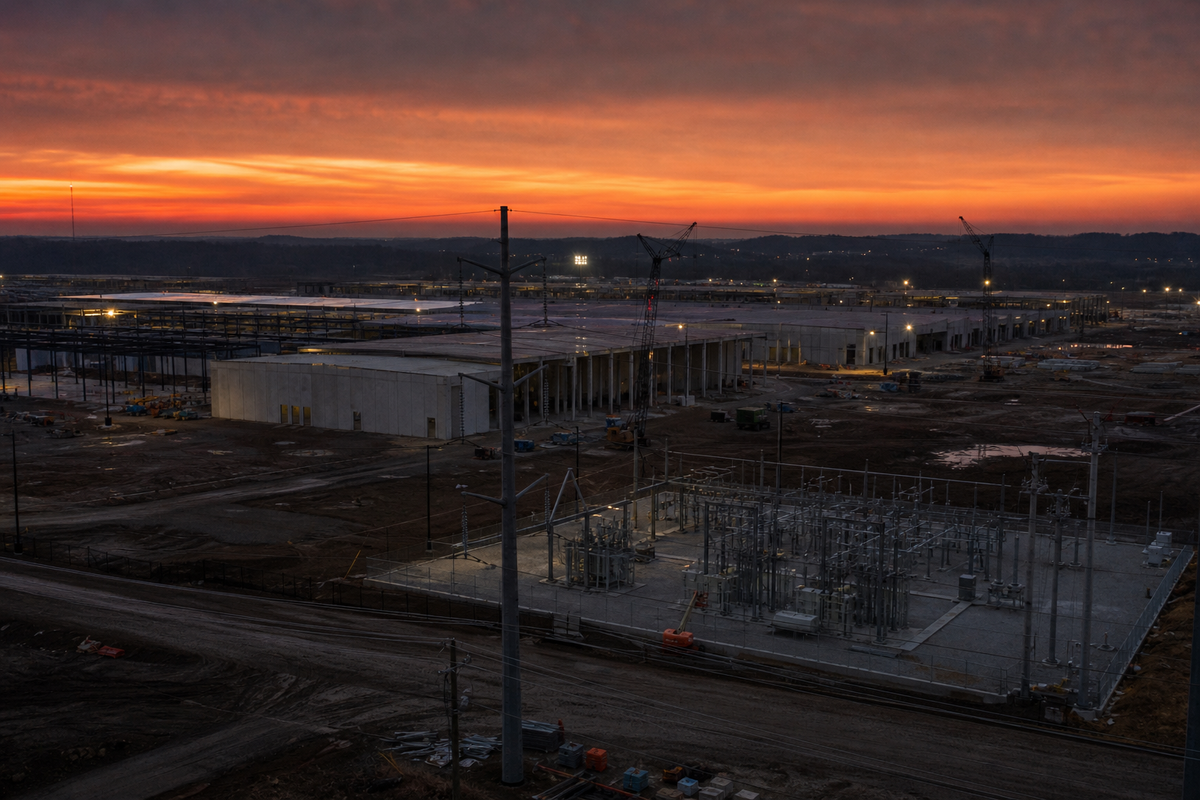
The number that matters most sits in the CFO commentary rather than the press release: maximum gross exposure on guarantees of $118.0 billion. That includes $105.0 billion of credit support Nvidia signed in August 2026 on behalf of SB Energy, backing the land, power and shell buildout for about 4.25 gigawatts across nine buildings at the PORTS-Pike Technology Campus in Ohio, a site that will exclusively host Nvidia infrastructure under 20-year leases to OpenAI. The guarantees take effect phase by phase as each building is completed, with the first expected in fiscal 2029, and exposure builds to that $105 billion peak before declining over each lease term as OpenAI makes payments. Nvidia says it has made no payments on them.
Why would a chip vendor guarantee real estate? The commentary is unusually direct: neoclouds and frontier labs are growing faster than their balance sheets and long-term credit profiles can support, so Nvidia entered arrangements to help select customers secure land, power and data center capacity. It says it will concentrate on sites where visible, durable demand can support multiple generations of its compute, and in the prior quarter it put a number on Pike: each generation of infrastructure deployed there could represent about 1.5 million GPUs, or roughly $150 billion to $200 billion in Nvidia revenue.
The guarantee is larger than the cash pile
Set that exposure against Nvidia's own resources. Cash, cash equivalents and marketable debt securities stood at $53.5 billion at quarter end, about half the SB Energy commitment alone. Total future commitments across supply, cloud service agreements, data center leases, equity investments and capital expenditures reached $518 billion. Supply commitments alone jumped to $390 billion from $279 billion, primarily to lock up multi-year memory supply, while cloud service agreements and lease commitments rose to $102 billion from $74 billion, with terms up to 20 years that have not yet commenced.
Receivables tell a related story. Accounts receivable hit $81.0 billion, with 64 days sales outstanding up from 60, driven by shipment timing around the Rubin launch and extended payment terms on large multi-quarter agreements with certain investment-grade customers. Inventory climbed to $39.7 billion from $31.6 billion to support the same ramp. Gross margin, meanwhile, steps down from 74.8% to a guided 71.0% to 72.0%, with operating expenses of about $11.0 billion. Growth is accelerating, and each incremental dollar now arrives with more balance sheet attached.
What the market is repricing
The quarter beat on revenue, by more than $6 billion against the $109.10 billion analysts expected, and the guidance topped consensus. Investors sold anyway. The reaction spread to the customers Nvidia is now guaranteeing: CoreWeave closed down 4.13% and Iren fell 3.61%, while Nebius edged up 0.87%. The leadership backdrop added to it. Former chief executive Jensen Huang resigned the week before, and board chair Harvey Jones said on the call that the board does not intend to reinstate him, leaving Colette Kress as interim chief executive and chief financial officer.
The disclosure itself shows how the arrangement is built to bend rather than break. The SB Energy guarantees phase in only as buildings are completed and ready for service. Nothing falls due on the $32 billion of neocloud agreements in the remainder of fiscal 2027, and those commitments take effect only if the neoclouds secure financing, deploy the capacity, make it operational and win Nvidia's acceptance. That structure is what makes the exposure hard to price: it is contingent, staged and long-dated, and it grows only if the demand it supports shows up.
The vendor has become the backstop
Demand is not in question. Hyperscale revenue was $60.1 billion, and AI Clouds, Industrial and Enterprise reached $47.5 billion, up 195% from a year earlier. What is changing is the structure underneath. Nvidia is no longer only selling compute. It is guaranteeing the land, power and shell that compute depends on, with $105 billion committed to a single Ohio campus and $53.5 billion of cash and securities on hand. The credit risk of the AI buildout is migrating from customers' balance sheets to their supplier's, and the market has begun charging for the difference.