Tech Stocks Had Their Worst Session Since 2020. Defense AI Raised $2.5 Billion the Same Day.
While public tech logged its worst day since 2020, defense startup Shield AI closed a $5.3 billion radar deal on a $2.5 billion raise at a $28.8 billion valuation.
Public markets delivered a verdict on AI infrastructure on Thursday, November 5, 2026. The Nasdaq Composite sank 5.5% into correction territory, the S&P 500 fell about 4.4%, and the Dow dropped roughly 1,833 points, or about 3.4%. The Magnificent Seven lost more than $1 trillion in market value that session, led by Nvidia at a loss of more than $440 billion after its shares fell more than 9%. Information technology was the worst S&P 500 sector, down 7.30% in its steepest session since March 16, 2020. The worry on the tape was that Democrats' sweeping midterm victory could slow the AI data-center buildout that carried public technology stocks.
That same Thursday, Shield AI, the San Diego defense technology company behind Hivemind autonomy software and the V-BAT and X-BAT aircraft, announced a definitive agreement to acquire Echodyne Corp. in a transaction valued at $5.3 billion. To fund it, Shield AI is raising $2.5 billion: a $1 billion Series H at a $28.8 billion post-money valuation, a $1 billion structured equity investment from funds managed by Blackstone, and $500 million of debt financing led by JPMorgan Chase Bank. Chief executive Gary Steele is attaching a radar franchise to an autonomy stack on the day listed AI names were marked down.
A staged price and a three-part raise
Of the $5.3 billion transaction value, $4.8 billion is paid and issued at closing. Up to $500 million is contingent on Echodyne meeting agreed performance targets. Even at this scale, part of the consideration depends on the target clearing operating hurdles, not just the closing headline.
The capital around the agreement is as important as the purchase price. The Series H is co-led by Disruptive and Innovation X Capital, with participation from Advent, the Strategic Investment Group of JPMorganChase's Security and Resiliency Initiative, Snowpoint Ventures, Apandion, Center15 Capital, and others. Growth equity, a structured check from a large alternatives manager, and bank-led leverage cleared in private while public investors cut the multiple on AI infrastructure.
The acquisition is expected to close in early 2027, subject to regulatory approvals and customary closing conditions. Until then, Shield AI has a signed agreement, a staged price, and a $2.5 billion package, not a completed merger. The $28.8 billion post-money valuation is the private mark investors were willing to underwrite while the Nasdaq was in a 5.5% slide.
What Echodyne puts on the air
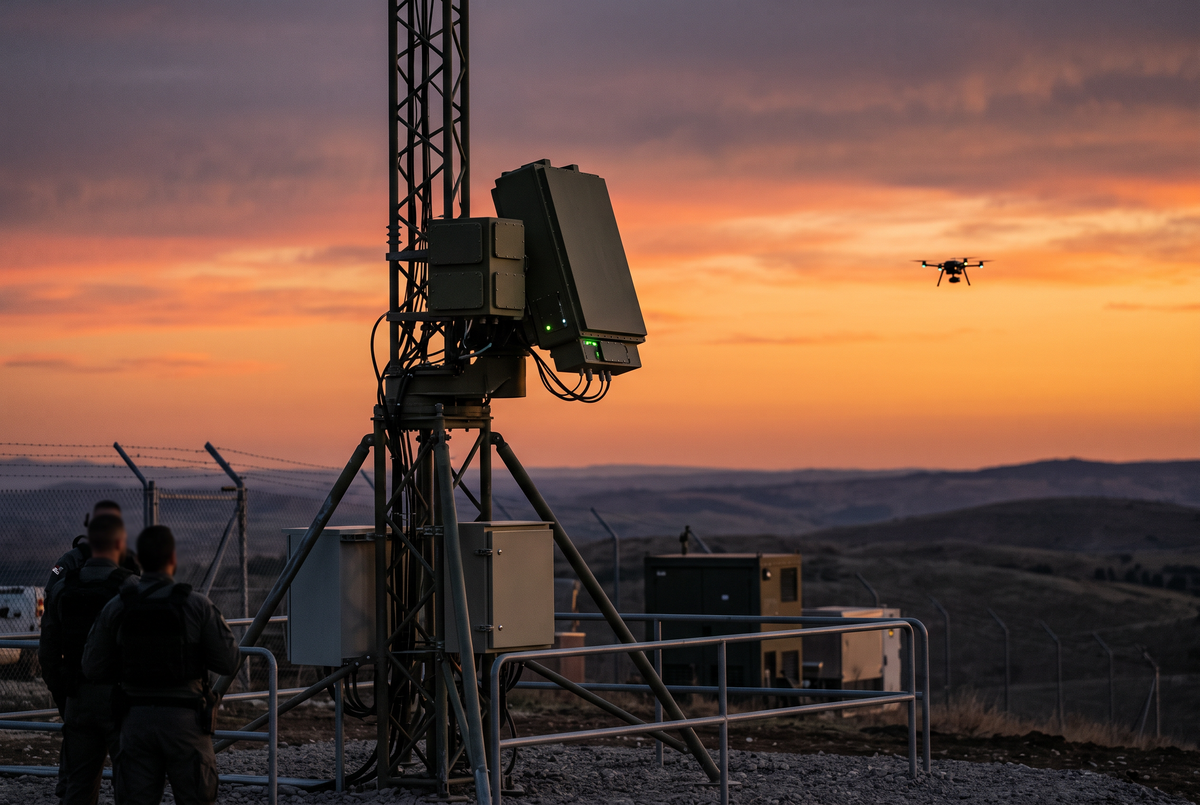
Echodyne, based in Kirkland, Washington, designs and manufactures compact solid-state radars on its patented Metamaterials Electronically Scanned Array (MESA) technology. Those radars are built into hundreds of counter-drone (C-UAS) and security systems used by defense, government, and commercial customers in more than 40 countries. The product is a sensor for small unmanned aircraft and security missions, and it sells to militaries, agencies, and commercial security operators rather than to hyperscalers adding GPU halls.
Demand already has a named government vehicle. In September, Echodyne received a contract with a $250 million ceiling from Joint Interagency Task Force 401 to supply counter-drone radar to U.S. and allied forces. A ceiling is a procurement envelope rather than revenue already in hand, and it helps explain why an autonomy software company would pay billions for a radar maker instead of treating sensing as a side project.
Factory capacity is coming in parallel. Echodyne recently opened an 86,350-square-foot manufacturing facility, a $40 million investment, with capacity to produce about 30,000 radars per year. MESA only works if the hardware ships at volume, so the Kirkland plant is the physical constraint under the equity story. Both companies expect triple-digit revenue growth this fiscal year, an outlook that now sits beside a private valuation public markets were no longer granting to listed AI names on Thursday.
Where private defense capital still clears
November 5 split AI capital by end market. In public markets, the fear was a political shift delaying data-center spending, the cash-flow story behind the largest listed AI stocks. In private markets, Shield AI's package treated autonomy software, unmanned systems, and counter-drone radar as a different duration bet: government and allied demand, a $250 million-ceiling task-force contract already on the target, and a factory sized for tens of thousands of units a year.
Blackstone funds committing $1 billion of structured equity to a $28.8 billion post-money defense-tech company on the same session Nvidia lost more than $440 billion of market value is the pricing gap in one line. JPMorgan showed up twice, in the $500 million debt package and through the Strategic Investment Group of its Security and Resiliency Initiative in the Series H. Disruptive and Innovation X Capital co-led the common round, with Advent, Snowpoint Ventures, Apandion, and Center15 Capital alongside.
That stack did not need a Nasdaq quote or confidence that hyperscaler capital expenditure would keep compounding. It needed a view that Hivemind, V-BAT, X-BAT, Aechelon, and now MESA radar belong in one company, and that customers in more than 40 countries will keep buying those sensors. The public tape marked down the data-center buildout. Whether the private price on battlefield sensing holds is the question an early 2027 close will answer.