A $400M Drug Has a Speed Problem. MediWound May Have the Answer. (Nasdaq: MDWD)
On Smith & Nephew's Q2 earnings call, CEO Deepak Nath acknowledged that dominant wound care product SANTYL is a "slower process." MediWound's EscharEx is already in Phase 3 targeting that exact disadvantage.

On Smith & Nephew’s second-quarter 2026 earnings call, CEO Deepak Nath acknowledged a key weakness in SANTYL, the company’s long-dominant wound care product. “One of the disadvantages is that it is a slower process,” Nath said. Smith & Nephew then revealed that it is developing a next-generation version designed to work faster. It did not say how far along that effort is or when it could reach the market.
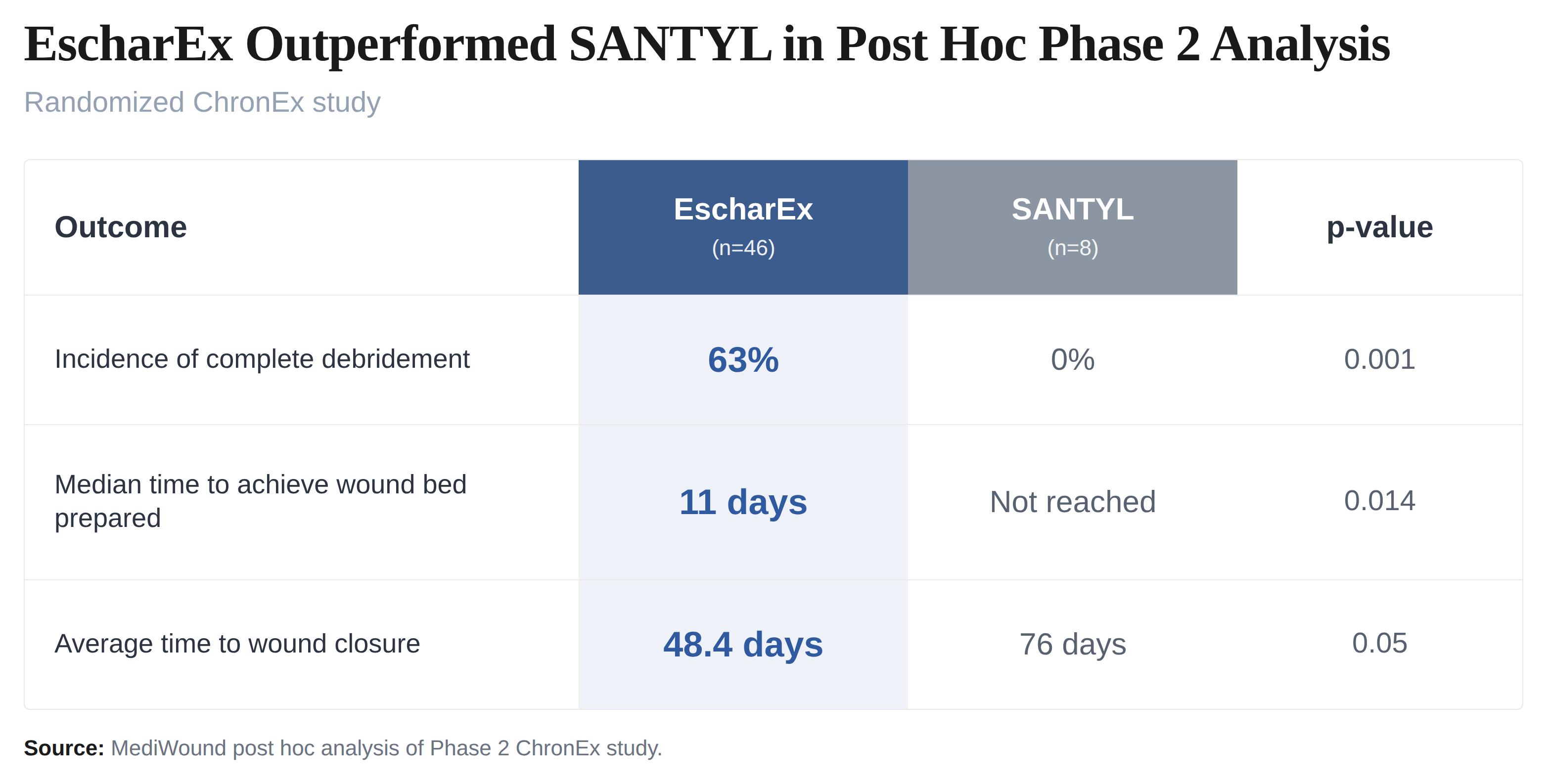
That admission highlights exactly the problem MediWound (Nasdaq: MDWD) has spent years preparing to solve. While Smith & Nephew is only now working on a faster version of SANTYL, small-cap MediWound already has a potential rival called EscharEx in a late-stage trial. According to a post hoc analysis of their study, in a short 2-week timeframe MediWound’s EscharEx completely cleared dead tissue in 63% of patients, versus 0% for SANTYL. Even in this small study, the results were statistically significant.
SANTYL is not a niche product that appeared yesterday. It has been used since its FDA approval in 1965 and has remained a standard treatment for clearing dead tissue from chronic wounds. Smith & Nephew does not break out SANTYL sales separately, but the product sits inside its Advanced Wound Bioactives franchise, which generated $621 million in 2025 and grew at a mid-single-digit rate. The point is that MediWound is not trying to create a market from scratch. It is developing a product that could completely disrupt an entrenched product inside a large, established wound-care business.
In the same randomized Phase 2 study, EscharEx cleared enough dead tissue to prepare the wound for healing in 78% of patients, compared with 38% treated with SANTYL, also a statistically significant result. In fact, while the study was small, the results were statistically significant across almost every endpoint measured. MediWound has since moved EscharEx into a large Phase 3 trial for chronic leg wounds caused by poor circulation, one of the common uses for SANTYL. The key question now is whether that apparent advantage over SANTYL can be confirmed in a much larger, late stage trial.
The size gap makes the setup even more striking. MediWound estimates SANTYL generates more than $400 million in annual sales, while MediWound itself is valued at roughly $170 million. Much of the company’s current value can be attributed to its existing commercial product - NexoBrid. NexoBrid is an FDA-approved enzymatic treatment for removing dead tissue from severe burns, with reaffirmed 2026 revenue guidance of $24 to $26 million in the company’s most recent quarterly release. Vericel, which holds the North American license for NexoBrid, has reported growing adoption across US burn centers and expanding order volume. BARDA also awarded Vericel a contract worth up to $197 million over ten years covering procurement and potential next-generation manufacturing.
That commercial track record matters because biotech stories often ask the market to underwrite several things at once: whether the science works, whether regulators approve it and whether the company can actually get a product into the market. MediWound has already cleared those hurdles with NexoBrid. While NexoBrid does not prove that EscharEx will succeed, it shows the company is not starting from zero when it comes to FDA approval experience, working with a commercial partner or selling an enzymatic wound-care product.
MediWound estimates the U.S. opportunity across key chronic wound indications at more than $4 billion. Even a modest share could be meaningful relative to the company’s current size. Smith & Nephew’s decision to develop a faster successor to SANTYL reinforces the importance of the exact weakness MediWound has spent years targeting. The question now is whether Phase 3 can confirm those earlier results.
Recent News Highlights from MediWound (Nasdaq: MDWD)
Newly Published U.S. Expert Consensus Aligns with MediWound's Strategy for Chronic Wound Debridement
MediWound Reports BARDA Contract Award to Vericel for NexoBrid® Valued at up to $197 Million
Read this Next >>
Important Disclaimers and Disclosures: The author, Wall Street Wire, is a content and media technology platform that connects the market with under-the-radar companies. The platform operates a network of industry-focused media channels spanning finance, biopharma, cyber, AI, and additional sectors, delivering insights on both broader market developments and emerging or overlooked companies. Wall Street Wire is not a broker-dealer or investment adviser. References to market size estimates, valuations, price targets, or other third-party data are provided strictly for informational purposes. Wall Street Wire receives cash compensation from MediWound Ltd. (the "Issuer") for coverage and awareness services, which are provided on an ongoing subscription basis. The content above is a form of paid advertising and promotion and is for informational purposes only and does not constitute financial or investment advice. This article may contain forward-looking statements about the Issuer’s products, plans, or prospects that are subject to risks and uncertainties; actual results may differ materially, and readers should review the Issuer’s public filings on SEC EDGAR (sec.gov/edgar) for full risk factors. Market size figures, research estimates, or other third-party data referenced in this article are quoted from publicly available sources believed to be reliable; however, we do not independently verify or endorse them, and additional figures or estimates may exist. Full compensation details, information about the operator of Wall Street Wire, and the complete set of disclaimers and disclosures applicable to this content are available at: wallstwire.ai/disclosures. This article should not be considered an official communication of the Issuer.