Blackstone Shrank a Data Center Debt Deal to Protect Its Cost of Capital
QTS raised about $300 million instead of $800 million rather than pay the yields investors wanted. The 245-basis-point spread on its private placement is the number the rest of the AI buildout now has to clear.
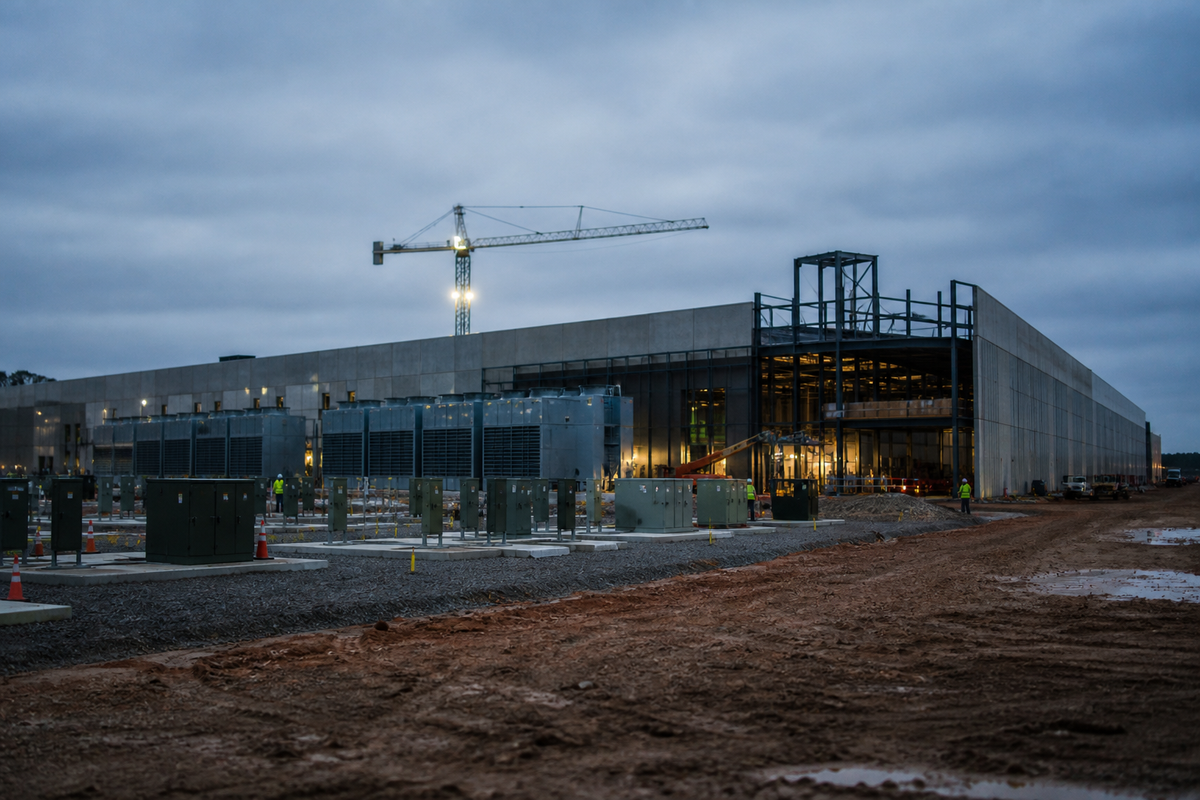
QTS, the Blackstone-backed data center operator, had planned to raise about $800 million in the private debt market. Instead it walked away with roughly $300 million, cutting the sale by about 60% rather than paying the yields investors demanded, Bloomberg reported. The tranche that did price explains the retreat: a $100 million seven-year US private placement, sold on Friday at 2.45 percentage points over benchmarks. If that level holds, it becomes the reference point the rest of the AI buildout has to clear, and it was set the week Nvidia reports.
The mechanics matter as much as the size. QTS had lined up the $800 million to refinance existing five-year bank debt. With the smaller offering, that bank financing stays in place, so the company is not left scrambling for a replacement. The $300 million package pairs the private placement with a $200 million five-year bank loan portion expected to price in the coming weeks. Some investors balked at the price on offer. Others were already full. QTS has tapped the private placement market several times, and the buyers who dominate it, life insurers and asset managers that hold debt to maturity, can cap how much exposure any one of them will build to a single borrower over a short stretch.
The arithmetic of that constraint is visible in the market's own numbers. Issuance in the investment-grade true private placement market ran just above $200 billion last year, according to the Private Placement Monitor, a small pool next to the public bond market. QTS had already raised billions there over the past 18 months, including a $1.65 billion high-grade bond sale last year and a separate $800 million financing. It has also sold project finance green bonds this year, borrowing $4.6 billion in April and $3.9 billion in August.
The terms point to a deliberate choice. Blackstone was reluctant to offer significantly higher yields because it finances frequently across multiple markets and issuers, and wider pricing on the QTS transaction could establish a more expensive reference point for investors weighing other Blackstone-related debt. The firm took a smaller cheque to avoid resetting what its name costs. A Blackstone representative declined to comment.
That decision only makes sense against a sector repricing that has been building since the summer. At the end of June, fixed-rate data center AAAs priced at 128 basis points over Treasuries. By Oct. 16 they were at 161, while the median fixed-rate senior bond in other single-asset single-borrower deals moved from 122 to 133. Then the sell-off arrived. Across the 19 single-asset single-borrower CMBS deals backed by data centers, senior AAA bonds widened 21 basis points in the week ending Oct. 23 for fixed-rate deals, to 182 over Treasuries, and 24 basis points for floating-rate deals, to 199 over SOFR. Over that same week the median senior bond in other single-asset single-borrower deals and in conduit deals was essentially unchanged, per Trepp.
The full-year comparison is starker still. Since year-end, fixed-rate data center AAAs are 60 basis points wider and floaters 32 basis points wider, against 1 and 7 basis points for other single-asset single-borrower deals and zero for conduit. Of the 64 rated data center bonds outstanding at year-end, 60 are wider today. The exceptions are telling: mostly Blackstone floaters, with BX 2025-VLT7 moving 2 basis points this year and BX 2025-VLT6 15 basis points. Every loan behind these deals is current and none is with a special servicer, which points to supply and sentiment rather than credit deterioration. The distinction is worth holding onto. Borrowers are paying more for the same assets, and the collateral has not yet broken.
The rate backdrop did the deal no favors. Treasury's daily curve put the 10-year at 5.12% and the 2-year at 4.83% on Nov. 16, so a 245-basis-point private placement spread sits on top of a benchmark that has already repriced. Monday was not a friendly session either: the Nasdaq fell 2.49% to 24,509.76 for a third straight decline, the S&P 500 lost 1.92% to 7,416.59, and Nvidia shares dropped 4.1% before its results. Some of CoreWeave's own bonds have traded at yields of 15% or more this autumn, which is what the far end of this market looks like.
What happens next is still forming. Nvidia reports third-quarter fiscal 2027 results after the close on Tuesday, and the print will either settle the sell-off or feed it. QTS's $200 million bank loan has yet to price, and its level will show whether the private placement spread was an outlier or a floor. Blackstone bought QTS in 2021 for about $10 billion including debt, and the operator has spent this year borrowing from every pool available to it. One borrower chose size over price. Whether the rest of the buildout can still finance itself at the spreads it liked in June is the question the next few weeks will answer.