J&J Is Buying a Retina Drug and Handing Blackstone the Phase 3 Bill
J&J is paying $2.2 billion for a Phase 3 retinal drug, then letting Blackstone cover the $750 million trial bill in exchange for single-digit royalties. It is at least the fourth such deal Blackstone has signed in nine months.
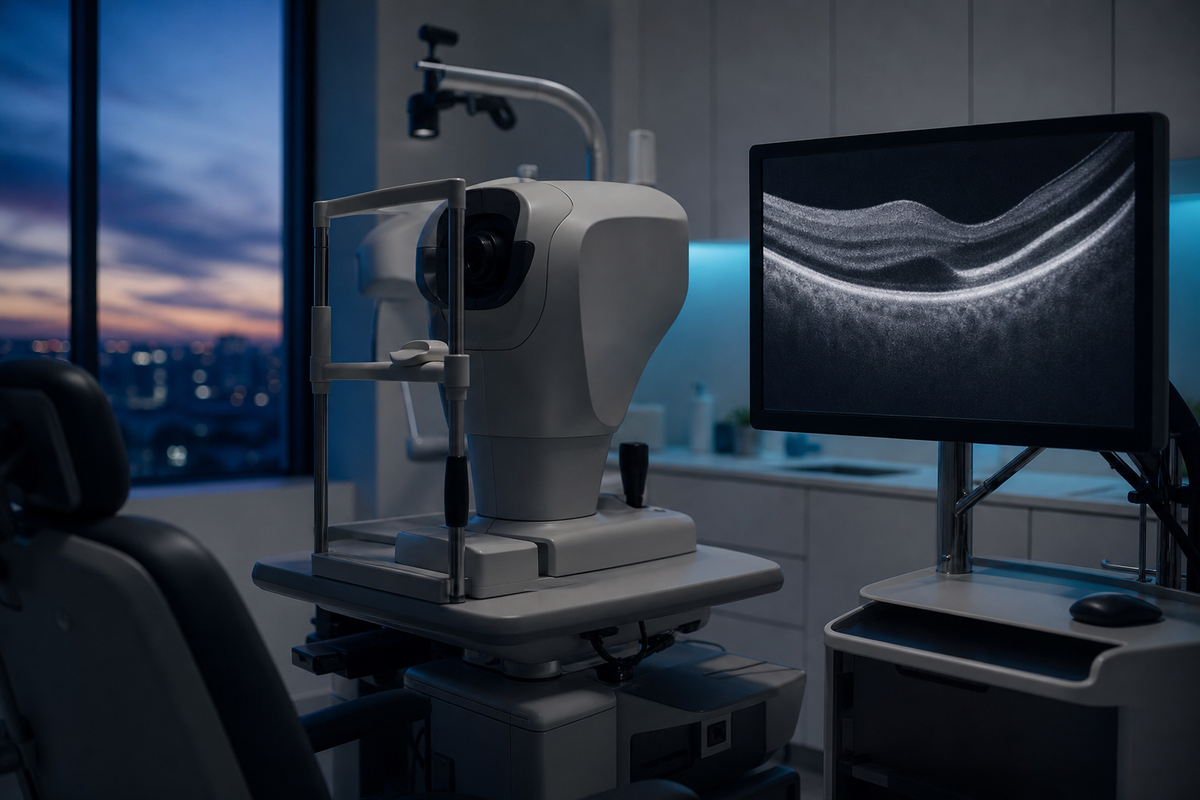
Johnson & Johnson agreed on Monday to acquire Ollin Biosciences for $2.2 billion upfront, with up to about $1.125 billion more in regulatory and commercial milestones, the company said in a release. OLN324, the asset at the center of the deal, is a bispecific antibody targeting VEGF and Ang2 that is already in Phase 3 for wet age-related macular degeneration and diabetic macular edema, conditions J&J says together affect more than 40 million people worldwide. The acquisition is expected to close before the end of 2026.
Attached to it is a second agreement that matters more than the first. J&J is entering a development funding arrangement with Blackstone Life Sciences, contingent on the close, under which Blackstone-managed funds will provide $750 million to support the Phase 3 program, a figure Blackstone confirmed in its own statement. In exchange, Blackstone is entitled to certain regulatory and sales milestone payments and single-digit royalties. J&J is buying the drug outright and still handing the bill for its pivotal trial to private capital, paying for the privilege with a slice of the revenue if the drug works.
The pattern, not the exception
Blackstone Life Sciences has signed at least four of these arrangements with drugmakers in the past nine months, and its assets under management have grown from $15 billion in March to $18 billion. In March it provided Teva $400 million over four years to fund development of duvakitug, then a Phase 3 antibody for ulcerative colitis and Crohn's disease, in return for regulatory and commercial milestones plus low single-digit royalties on worldwide sales, terms Teva disclosed. In May, Apogee Therapeutics secured up to $1.3 billion in non-dilutive capital, including up to $800 million of synthetic royalty funding on zumilokibart over a 15-year term, with royalties stepping down as sales rise and ending entirely above $8 billion in global annual sales. Kiran Reddy, a senior managing director at Blackstone Life Sciences, called that the largest royalty financing for a pre-Phase 3 program to date.
The Pfizer agreement announced earlier this month commits more than any of them. Blackstone funds will pay up to $1.5 billion of development costs through 2028 for berobenatide, a monthly GLP-1 receptor agonist peptide in trials for chronic weight management, with Blackstone's payments contingent on U.S. approval of the monthly dosing and on commercial sales milestones, per the release. Pfizer plans to advance 20 or more trials for obesity and related comorbidities in 2026, including 10 ongoing and planned Phase 3 trials for the drug.
Why drugmakers are renting the balance sheet
The appeal is control. Blackstone acquires no rights or ownership in berobenatide, and Pfizer keeps full operational control and decision-making over the program. Pfizer finance chief Cecile Guegan described the logic as "a disciplined approach that pairs internal research investments with targeted investment from capital partners." Teva's business development head Evan Lippman made the same case in March, saying the model lets it accelerate its pipeline "while maintaining financial strength."
What those statements describe is a change in how the largest drugmakers fund late-stage development. A Phase 3 program means thousands of patients and multiple years, and it is now a cost that can be moved to a third party without giving up the asset. It gets paid later, and only if the drug reaches the market, through milestones and royalties drawn from the programs the companies have already decided are worth finishing.
What the royalty is worth
The closest read on what a single-digit royalty costs at scale is arithmetic on the current retinal market, not a projection for OLN324. Roche reported CHF 3,196 million in Vabysmo sales in the first nine months of 2026, up 10% at constant exchange rates, of which CHF 2,060 million came from the United States, according to its nine-month update. U.S. growth was 2%. A single-digit royalty on sales at that scale would run to the low hundreds of millions of dollars a year at a mid-single-digit rate. That is the upside Blackstone is underwriting across these deals, and what J&J has agreed to give away to move $750 million of trial cost off its own budget.
The morning's counterexample
Eli Lilly agreed the same morning to acquire Calytrix Bio, whose shareholders could receive up to $1.5 billion in cash including upfront and milestone payments, the company said in a statement. Its lead asset is a preclinical biparatopic antibody for mutant calreticulin-driven essential thrombocythemia and myelofibrosis that has not entered clinical development, and the company was founded in 2025 by J.P. Morgan Life Sciences Private Capital. Lilly is buying an early bet directly, with no financing partner disclosed. J&J is paying $2.2 billion for an asset already in Phase 3, then letting Blackstone carry the pivotal trial.
What to watch is whether the next large late-stage acquisition arrives with the same financing annex, and how the royalty terms move as more programs compete for that capital. The funding agreement goes live only if the Ollin deal closes, which J&J expects before the end of 2026.