Quantum Cyber N.V. Is Already Building Inside the U.S. Drone Tariff Wall Trump Just Put Up
A White House proclamation signed August 13, 2026 imposes sweeping tariffs on foreign drones and authorizes an onshoring program for domestic manufacturers, changing the economics of the U.S. drone industry with 21 days’ notice.

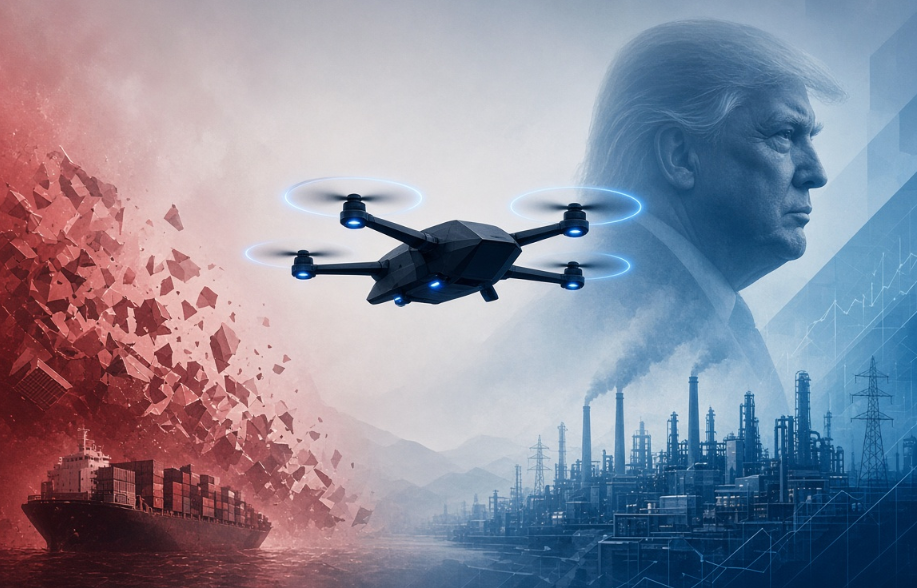
On August 13, 2026, President Donald J. Trump signed a Section 232 Proclamation imposing sweeping new tariffs on drones and drone components entering the United States. According to the White House fact sheet released the same day, drones with a maximum takeoff weight above 25 kilograms or thermal imaging capabilities, along with their docking stations and certain critical components, will be hit with a 100% ad valorem tariff. Smaller drones and other components face 25%. Drones and components from the European Union, Japan, the Republic of Korea, Switzerland, Liechtenstein, and Taiwan are subject to a 15% tariff, and the United Kingdom to 10%, but only where substantially all hardware, software, and technology originates within those countries and the United States.
Perhaps most consequential for the domestic industry: the Proclamation authorizes the Secretary of Commerce to establish an onshoring program for companies making new investments in manufacturing drones and drone components. The main tariffs take effect 21 days after signing, roughly September 3, 2026. Non-sensitive component tariffs kick in at 180 days. Products approved by the Department of War for exemption from the Federal Communications Commission’s Covered List within 20 days of signing get the same 180-day tariff delay.
Translation: after Labor Day, imported drones become dramatically more expensive to sell into U.S. buyers. Allied-country supply chains remain viable at a 10 to 15 percent premium, but only if hardware, software, and technology provenance is verified all the way down. And Commerce now has authority to extend tariff relief to U.S. manufacturers scaling production onshore. This is a supply-shock policy event, not a subsidy. It rewires the drone market’s cost curve in favor of companies producing on U.S. soil.
Quantum Cyber (Nasdaq: QUCY) has been openly building for exactly this environment.
In mid-July 2026, Quantum Cyber’s wholly owned subsidiary Quantum Drones Corporation completed the acquisition of an approximately 50,000-square-foot manufacturing facility at 38 Union Avenue in Bridgeport, Connecticut. On July 6, the company disclosed a targeted annual production capacity of approximately 100,000 drones from the site, spanning kamikaze one-way attack, interceptor, surveillance, VTOL, and long-range Phantom-950 platforms. On July 27, it announced completion of the first mini-interceptor drone assembled in-house at Bridgeport, with an 80-unit 3D printing production farm expected to come online shortly, designed to run on both standard PETG filament and Formula A, the company’s patent-pending EMP-hardened composite filament, both to be produced in-house through its Advanced Filament Manufacturing Division. That is the profile of a vertically integrated domestic producer with proprietary inputs, not a re-badger of imported airframes.
Two days after the mini-interceptor announcement, on July 29, the company issued a public statement congratulating the Trump administration on Version 2 of the Drone Dominance Program Supply Chain Framework (DDPSCF), a $1.1 billion Department of War advanced market commitment to procure over 200,000 Group 1 one-way attack sUAS across four phases, with progressively tightening domestic sourcing requirements. Peter O’Rourke, President of Quantum Drones Corporation and a former Acting Secretary of the U.S. Department of Veterans Affairs under President Trump, described the DDPSCF as “a serious, credible demand signal to industry” that the U.S. intends to source its autonomous systems from a domestic industrial base not dependent on adversary nations. This week’s tariff proclamation puts hard economic teeth on precisely that thesis.
CEO David Lazar has been direct about the strategy from the start: “100,000 drones per year, from a single facility we own and operate, is the target. Bridgeport is not a concept. It is a production address.” Chairman Robert Liscouski, a former Assistant Secretary for Infrastructure Protection at the U.S. Department of Homeland Security and co-founder and former Chairman and CEO of a Nasdaq-listed quantum computing company, sits on the Quantum Drones board alongside O’Rourke. The macro backdrop remains substantial. Executive Order 14307, signed in June 2025, established American drone dominance as an explicit national security priority, and the U.S. Department of Defense FY2027 Budget Request includes approximately $55 billion toward drone and autonomous warfare programs.
For category context, names such as AeroVironment (Nasdaq: AVAV), Kratos (Nasdaq: KTOS), Red Cat (Nasdaq: RCAT), and Ondas Holdings (Nasdaq: ONDS) have already been repriced against this pivot as the domestic autonomous defense platform playbook has been validated. Quantum Cyber has been assembling its own version of that playbook, combining licensed drone IP, domestic production infrastructure, and Trump-era credentialing on the board, on a much smaller base. It remains an early-stage micro-cap where execution risk is real, previously stated production capacity targets are management projections rather than binding commitments, and there can be no assurance the company will be invited to compete in, qualify for, or receive any award under the Drone Dominance Program.
What to watch from here: how quickly the Commerce Department stands up the Section 232 onshoring program authorized by the Proclamation and what its qualifying criteria look like; whether Quantum Drones’ Bridgeport site can be positioned as an early beneficiary; the September 3 effective date for the main tariff tranche; Phase II qualification and phased sourcing compliance under the DDPSCF; commissioning of the 80-unit 3D printing production farm; and the pace at which the company advances its previously disclosed U.S. Army program submission.
The White House just drew a hard line between drones built inside the tariff wall and drones built outside it. Quantum Cyber has been publicly building on the inside.
Recent News Highlights from Quantum Cyber (Nasdaq: QUCY)
Quantum Cyber Completes Acquisition of U.S.-Based Manufacturing Facility in Bridgeport, Connecticut
Quantum Cyber Reports Approximately $2 Million of Purchase Orders for Quantum Drone Corporation
Quantum Cyber Completes Confidential Submission to U.S. Army Program
Quantum Cyber Files for Drone Launch System Designed to Field Attritable Autonomous Drones at Scale
Read this Next >>
Trump's New Drone Tariff Could Benefit These Under the Radar Stocks (NASDAQ: EMAT)
Important Disclaimers and Disclosures: The author, Wall Street Wire, is a content and media technology platform that connects the market with under-the-radar companies. The platform operates a network of industry-focused media channels spanning finance, biopharma, cyber, AI, and additional sectors, delivering insights on both broader market developments and emerging or overlooked companies. Wall Street Wire is not a broker-dealer or investment adviser. References to market size estimates, valuations, price targets, or other third-party data are provided strictly for informational purposes. Wall Street Wire receives cash compensation from Quantum Cyber N.V. (the “Issuer”) for coverage and awareness services, which are provided on an ongoing subscription basis. The content above is a form of paid advertising and promotion and is for informational purposes only and does not constitute financial or investment advice. This article may contain forward-looking statements about the Issuer’s products, plans, or prospects that are subject to risks and uncertainties; actual results may differ materially, and readers should review the Issuer’s public filings on SEC EDGAR (sec.gov/edgar) for full risk factors. Market size figures, research estimates, or other third-party data referenced in this article are quoted from publicly available sources believed to be reliable; however, we do not independently verify or endorse them, and additional figures or estimates may exist. Full compensation details, information about the operator of Wall Street Wire, and the complete set of disclaimers and disclosures applicable to this content are available at: wallstwire.ai/disclosures. This article has not been reviewed or approved by the Issuer prior to publication and should not be considered an official communication of the Issuer.