The AI Chip Boom's Next Bottleneck Is Concrete, Not Silicon
Applied Materials posted record revenue of $10.41 billion, up 53%, and guided higher again. The constraint it flags next is clean-room construction, and Wall Street cut price targets on the stock anyway.
Applied Materials closed its fiscal year with a record quarter, and the market responded with a shrug. Revenue for the fiscal fourth quarter, which ended Oct. 25, 2026, came in at a record $10.41 billion, up 53% from a year earlier, with GAAP gross margin at 50.4%, record operating income of $3.66 billion and GAAP earnings of $3.40 per share. Non-GAAP earnings reached $4.16 per share, up 92% year over year, and the full year produced revenue of $34.45 billion, up 21%, with non-GAAP earnings of $12.89 per share, up 37%. LSEG consensus was $4.05 in earnings on $10.30 billion of revenue, so the company beat on both lines.
The first quarter of fiscal 2027 carries even more momentum. Guidance calls for revenue of $11.1 billion, plus or minus $500 million, up 58% at the midpoint, and non-GAAP earnings of $4.35 per share, plus or minus $0.20, up 83% at the midpoint. CFO Brice Hill described the quarter as the highest dollar growth in the company's history, alongside the largest quarterly share buyback in more than eight years: $2.00 billion of stock repurchased and $421 million paid in dividends.
Investors did not reward any of it. The stock closed at $380.95 on Nov. 12 and traded roughly flat in premarket Friday despite the beat-and-raise, leaving shares up more than 65% over the past year. At least ten firms trimmed their price targets on Friday, including JPMorgan, Goldman Sachs, Bank of America, UBS, Wells Fargo and Jefferies, though all of them kept Buy-equivalent ratings. JPMorgan pointed to severe multiple compression across chip equipment stocks, and even the lowest target on the board, Needham's $470, implied roughly 23% upside. Morningstar stood alone, raising its fair value to $570 from $520 and calling AI market concerns overblown. Nobody is cutting forecasts on the business; they are cutting targets on the valuation of a stock that has already re-rated.
The Mix Moved Toward Memory and Packaging
Beneath the headline numbers, the composition of demand is shifting. The Semiconductor Systems segment generated $7,996 million in revenue, up 64% year over year, with record sales in both Korea and Taiwan. DRAM accounted for 33% of segment revenue against 28% a year earlier, and the company posted record DRAM revenue. Advanced packaging revenue is projected to rise about 90% in calendar 2026, while inspection and metrology is on track to grow more than 50%. That mix is where AI fabs are spending: memory density, chip stacking, and the yield control that keeps advanced nodes profitable.
Clean Rooms Are Now the Governor
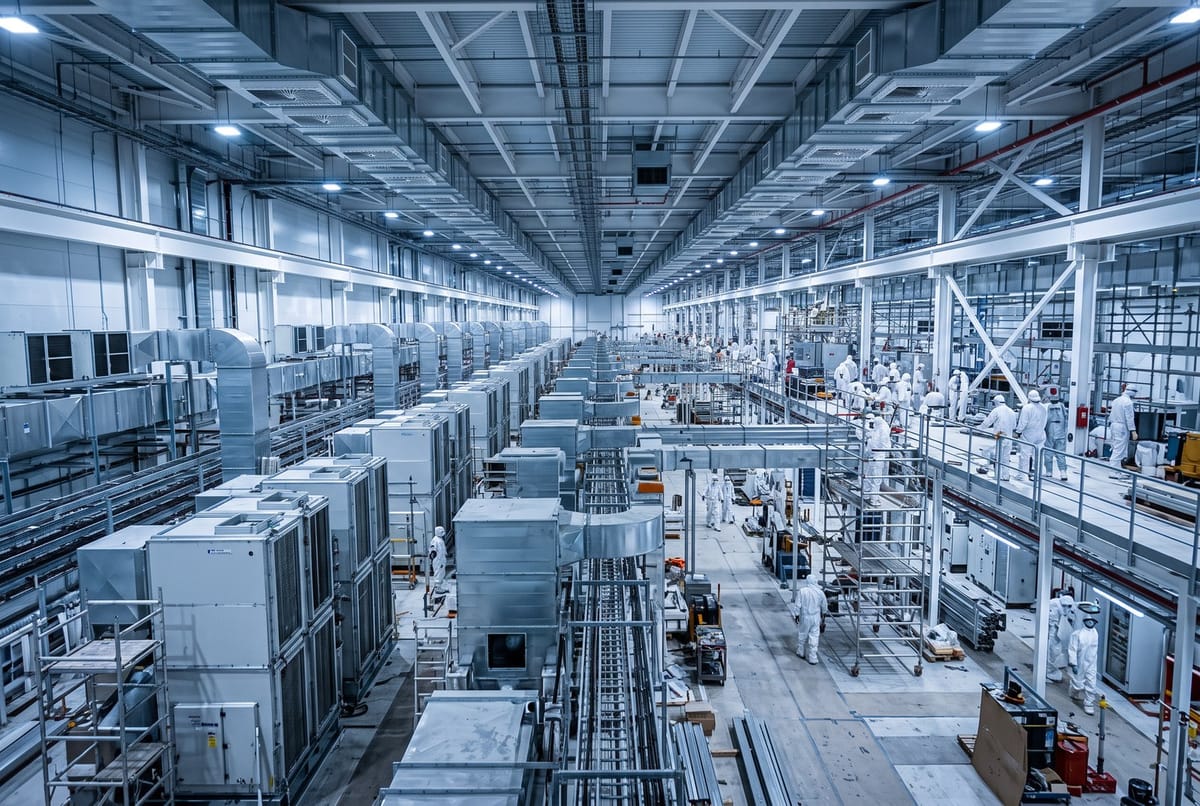
The more consequential message came one step upstream of the tools. On the earnings call, Hill said that clean room capacity remains a gating factor for how much equipment the industry can consume, and that Applied is tracking more than 20 fab ramps and line expansions for 2027 alone. Customers are adapting with rolling eight-quarter demand forecasts and earlier orders, which stretches visibility far beyond a normal equipment cycle.
The project pipeline backs that up. More than 10 new fab and expansion projects were added to the company's factory tracker for the third consecutive quarter, and many are not expected to come online until 2029 and 2030. Applied is responding with its own buildout, investing to double its systems output from fiscal fourth quarter 2026 levels by 2028 and to more than double manufacturing and lab capacity by 2030. Hill was candid about the friction, saying the first-quarter number would be slightly higher if everything were perfectly available. When a company guiding up 58% frames its shortfall in physical availability, the binding constraint has moved: a clean room is a construction project with permits, trades, and utilities attached, and it does not compress on request.
What 2027 Looks Like From Here
CEO Gary Dickerson said wafer fab equipment demand is expected to rise more than 30% in 2027, with leading-edge logic and DRAM fabs already running at full utilization. Hill added that cloud capital expenditures are projected to exceed $1 trillion in 2027, growing more than 50%, the spending pool that ultimately funds the fabs. China is expected to fall below 25% of the total business in 2027 as other regions grow faster, and non-China investment in mature-node ICAPS demand is expected to strengthen in the same year, so growth is diversifying geographically.
The company also deepened its research position: the EPIC Center in Silicon Valley added Intel as a founding partner along with KIOXIA, Besi and UCLA, bringing announced engagements to 15.
The record quarter and the flat stock tell the same story from opposite ends. Demand is verified, guided and pushed out years, and the equipment itself is no longer the scarce input. What gates the cycle now is concrete, steel and filtered air, which means the 2029-2030 project pipeline decides the growth rate as much as any tool order does. Wall Street's Friday price cuts were a debate about multiple, not momentum, and on the evidence of this quarter the momentum runs through building cranes before it runs through silicon.