The Memory Shortage Has Become a Consumer PC Recession
HP's newest quarter shows memory and storage climbing to 40% of a PC's bill of materials, units down 29%, and revenue still growing. The company is betting the price spike decelerates, and the data does not show that yet.
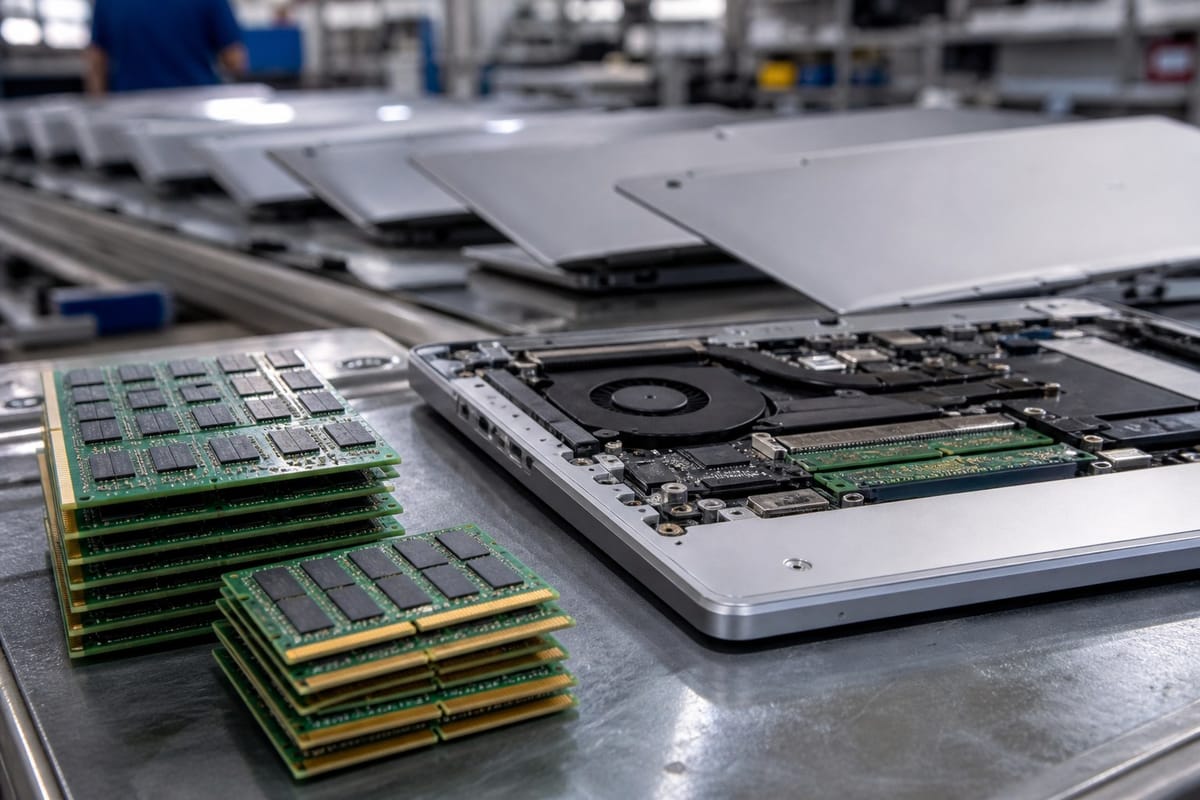
HP shipped 29% fewer personal computers in its fiscal fourth quarter than a year earlier, and revenue still grew. Personal Systems brought in $11.8 billion, up 14% year over year, even as total units fell 29% and consumer units fell 31%. That is the memory shortage arriving at the checkout: the same machines cost more to build, so they cost more to buy, and buyers at the low end have started walking away.
The mechanism is quantified in HP's own earnings call. CFO Karen Parkhill said memory and storage made up 15% to 18% of a PC's bill of materials at the start of fiscal 2026, and HP expected that share to double over the year. By fiscal Q4 it was closer to 40%, she said, according to the call transcript. A component stack that was roughly one sixth of the cost of building a laptop became two fifths of it in a single fiscal year.
HP passed the cost through. Parkhill said repricing and richer mix supported revenue growth but did not fully cover rapidly rising costs. The non-GAAP operating margin fell to 6.2% from 8.0% a year earlier, and non-GAAP diluted EPS came in at $0.83, down 10.8%, per the results release. Those earnings carried a $0.15 favorable impact from tariff refunds that will not repeat: HP has now received all refunds it applied for and assumes none in fiscal 2027.
The consumer side is where the break shows. Consumer Personal Systems revenue fell 7% while commercial rose 23%. Corporate buyers locked into refresh cycles can absorb a repriced laptop; a household shopping for an entry-level machine cannot, and consumer units down 31% is what that looks like in shipment data. TrendForce recorded the same dynamic at industry scale, reporting notebook shipments down 15.8% quarter over quarter in the third quarter of 2026, with a further single-digit decline possible in the fourth, as some PC makers rework 2027 procurement and plan more lower-specification, private-label models in their forecast. The same house projects PC DRAM contract prices rising 13% to 18% quarter over quarter in the fourth quarter.
The outlook is a smaller, pricier PC market
HP's fiscal 2027 guidance is built on that world: a PC unit market down high-single to low-double digits in calendar 2027, with revenue roughly flat as pricing and premium mix offset the unit decline. Fewer PCs at higher prices, and the numbers follow: fiscal 2027 non-GAAP EPS of $3.15 to $3.45 against $3.33, and free cash flow of $2.9 billion to $3.1 billion against $3.33 billion.
Dell printed the same quarter from the other side of the industry. Dell's fiscal Q3 revenue hit $54.9 billion, up 103% year over year, with its infrastructure group at $42.0 billion, up 198%, and AI-optimized servers at $22.0 billion, up 291%, per its results release. Its client business, the PC side, grew just 3% with operating income down 6%. The AI buildout is rewarding the companies that sell to data centers and taxing the ones that sell to desks, and the memory market is the transmission line between the two.
The bet underneath the guidance
HP's fiscal 2027 math rests on one assumption Parkhill stated on the call: memory and storage costs keep rising, but at a lesser rate than in fiscal 2026, even as CPU costs climb. The latest contract data does not yet confirm the deceleration. Conventional DRAM prices are projected to rise 10% to 15% quarter over quarter in the fourth quarter, with NAND Flash up 15% to 20%, according to TrendForce's September projection. Those are still steep sequential increases, not a flattening curve.
There are cushioning factors. AI PCs reached nearly 60% of HP's fiscal Q4 shipments, ahead of the company's own 50% target. HP also said it is confident it has all the components, including memory and storage, that it needs to meet fiscal 2027 demand, and inventory ended the quarter at $12.3 billion, up 11 days quarter over quarter to 84 days, consistent with buying ahead of the price curve. The Windows 11 refresh is mostly behind HP, per Parkhill, which removes a demand tailwind just as prices peak.
The genuine tension is what HP gives up while it waits. A premium-heavy mix and nearly 60% AI PC penetration may let it ride this cycle out profitably, but the mainstream consumer price band is where volume lives, and HP's own numbers show it hollowing: consumer revenue down 7%, consumer units down 31%, and a new $699 OmniBook 5 launched in October with what HP described as an improved cost structure, plus a new ProBook 4 arriving in November. If memory inflation decelerates on schedule, HP emerges with a richer mix and intact margins. If it does not, the flat-revenue assumption has to give somewhere, and the 11th consecutive annual dividend increase, to $0.31 a share, signals management intends to keep its cash commitments. Bruce Broussard holds the interim chief executive seat until Emma Walmsley joins on 4 January, which means the person inheriting the fiscal 2027 plan will not have set it.