Alpha Tau's Brain Cancer Therapy Shrank or Cleared Every Evaluable Tumor in Its U.S. Trial
New REGAIN data shows every evaluable patient responded to Alpha DaRT, and survival is now the number to watch in one of oncology's deadliest cancers.
 Sponsored · Market Discovery Content
Alpha Tau Medical's (NASDAQ: DRTS) Alpha DaRT therapy shrank or cleared the tumor in all six evaluable patients in its U.S. trial in recurrent glioblastoma, the company announced on November 15. The survival picture is encouraging too: in a disease where survival after recurrence is typically measured in months, all eight patients treated so far were alive as of November 11, and median overall survival had not been reached after a median follow-up of 6.9 months in the six evaluable patients. The results were presented as a poster at the Society for Neuro-Oncology's annual meeting in Philadelphia by the trial team at The Ohio State University Comprehensive Cancer Center.
The data arrived four days after a notable call from Wall Street. On November 11, Piper Sandler analyst Allison Bratzel upgraded Alpha Tau from Neutral to Overweight and raised her price target from $8 to $22, about 64% above the stock's $13.38 close on November 13. The move reversed a Neutral call she had made earlier this year.
Survival Is the Number That Counts in This Disease
The National Brain Tumor Society describes glioblastoma as one of the most complex, deadly and treatment-resistant cancers. About 14,000 Americans are diagnosed with it each year, the company reports, and the society puts average survival at roughly 8 months. Once the tumor returns after surgery, radiation and chemotherapy, options narrow sharply. In a large phase 3 trial published in the New England Journal of Medicine, patients at first recurrence who received the chemotherapy lomustine lived a median of 8.6 months, and adding the antibody bevacizumab did not meaningfully change that.
The REGAIN patients fit that profile. Each had already received radiation to the brain, and their recurrent tumors could not be removed surgically. That is why survival, not just tumor shrinkage, is the measure doctors watch most closely.
Alpha DaRT takes a different route from drugs that must travel through the bloodstream. Tiny sources carrying radium-224 are placed directly inside the tumor, here through a small burr hole in the skull rather than open surgery. As the radium decays, it releases atoms that emit alpha particles, a form of radiation that is highly destructive but travels only a fraction of a millimeter, so the dose is concentrated in the tumor rather than the healthy brain around it.
From Shrinking Tumors to Keeping Patients Alive
In May, the story was tumor response: two of the first three patients had complete responses, meaning the enhancing tumor disappeared on MRI. The new update widens and deepens that picture. All six evaluable patients achieved an objective response under standard neuro-oncology criteria: five complete responses and one partial response with a 58% reduction in tumor measurements. While the three most recent responses still await confirmation on later scans, the third patient, initially reported with stable disease, converted to a confirmed complete response with longer follow-up. The planned sources were placed successfully in all eight patients, with no unanticipated serious adverse events, and the one serious event previously reported, a seizure, resolved with steroids.
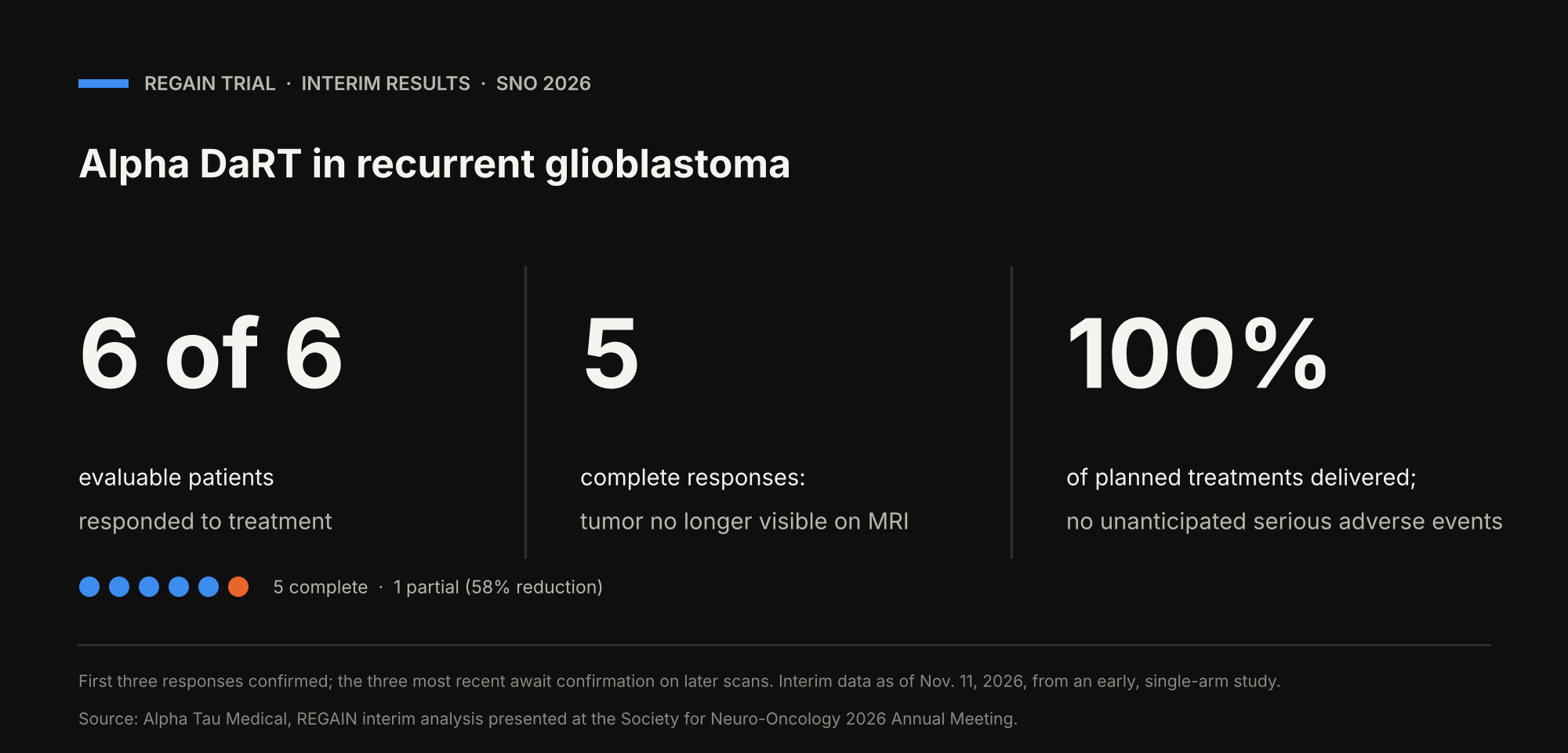
The picture is not finished. Follow-up scans in four of six patients show necrosis or suspected necrosis, asymptomatic changes that are a known effect of focused radiation in previously irradiated brain tissue; two patients have new scan findings still being evaluated, and the first patient treated developed progression away from the treated area about nine months after treatment. Yet no definitive recurrence has been seen in any treated area, and three patients have now been followed for more than eight months, all of them alive.
"All of our patients are alive," principal investigator Dr. Joshua Palmer said in the release.
What Comes Next for Alpha DaRT
The brain program is set to grow. In October, the FDA approved doubling REGAIN to up to 20 patients across three U.S. academic centers, and the company says that, based on initial discussions, enrolling toward 20 patients may support market submission requirements. Alpha DaRT already holds the FDA's Breakthrough Device Designation in recurrent glioblastoma, and Alpha Tau participates in the agency's TAP advisory program for devices.
Brain cancer is one track among several. The company has completed enrollment of 88 patients in ReSTART, its U.S. pivotal trial in recurrent skin cancer, and has begun a modular application for FDA approval. Its IMPACT pancreatic cancer study finished enrolling 48 patients after three expansions. In Japan, Alpha DaRT is already approved for certain head and neck cancers. Alpha Tau was valued at about $1.2 billion at the November 13 close.
For a cancer in which median survival after recurrence has long been measured in single digits of months, eight patients alive is a small number with a large meaning. REGAIN is still an early, single-arm study, and the coming months will show whether the open scan findings resolve as necrosis and whether survival holds past the benchmarks the field knows well. Management is scheduled to discuss the data on a conference call at 8:30 a.m. ET today. With enrollment doubling and Piper Sandler's rating back at Overweight, Alpha Tau looks like one to watch as that clock keeps running.
Recent News Highlights from Alpha Tau (NASDAQ: DRTS)
Alpha Tau Announces Second Quarter 2026 Financial Results and Provides Corporate Update
Read this Next >>
Why Alpha Tau's TASE Listing Could Matter More Than Investors Think
Wall Street Sync newsletter
Get Wall Street Sync in your inbox
Market news and analysis, delivered free. Unsubscribe anytime.